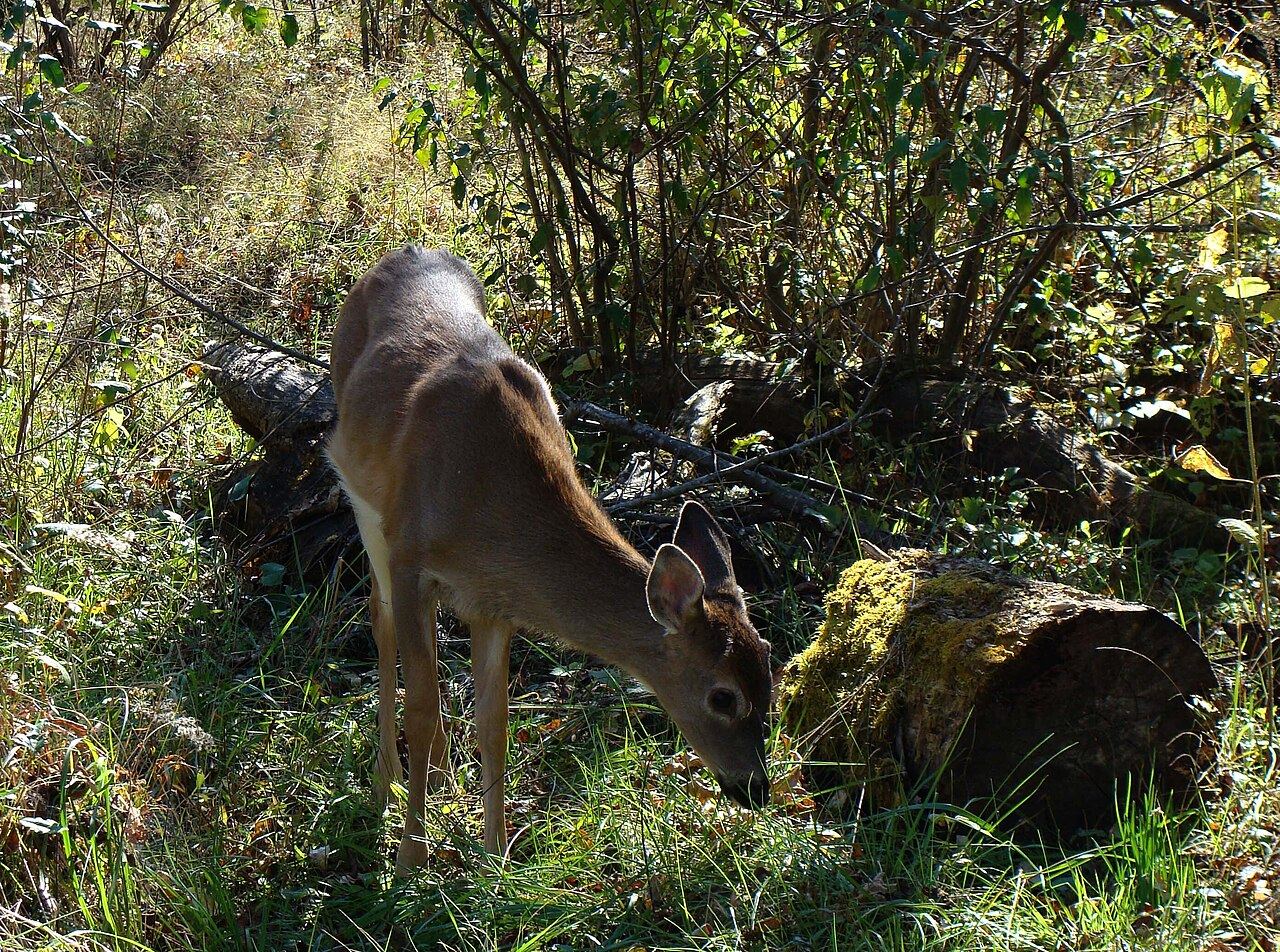
A wild whitetail eats what the season offers. In spring it is the first green growth. In summer the menu is at its widest. In fall the woods turn to fruit and hard mast. In winter it is woody browse — twigs, buds and evergreen tips — because that is what is left within reach.
Wild browse, not the Deer Streams trough. Photo: Dave Bieri, National Park Service. Public domain.
On the Deer Streams cam the meal is simpler. Oats are the base feed, every day of the season. Apples, carrots, squash and pumpkins are added on top. A season uses about 14,000 pounds of oats. The treats are the part people ask about, and they have their own answers below — but they are not the meal. The oats are the reason the herd walks into the clearing.
Whitetails are ruminants. The first swallow is not the end of the meal. The chewing often finishes later, out of sight of the lens, when the deer has stepped back into cover.
Can deer eat...?
Food
Quick answer
Link
Carrots
Yes. Deer like carrots, and they can have them. On this cam they are a treat on the oats, not the everyday feed.
After winter, wild whitetails take the first green growth. A provincial wildlife habitat summary says young grass shoots are a typical early-spring food, and that deer also browse shrubs when those are in reach. What they find depends on what has started to grow — spring is not one menu for every forest in Canada. A deer eats what is growing nearby.
Summer: the widest menu
Summer food is broader. The same summary lists grasses, fruits, forbs, leaves, nuts and flowers, and also lichen and fungi where the woods have them. The Canadian Wildlife Federation names young grass and plants such as jewelweed, asters and goldenrod, plus elderberry and raspberry.
This is the season when a deer can afford to be choosy, and when the food is at its richest. It is also the season the cam does not show: the live season runs November 1 to March 31, so the summer diet is the wild diet, not the trough.
Fall: fruit, mast and the turn to browse
Green forbs thin out, and woody browse takes a larger place. Fruit is eaten where it is ripe. The Canadian Wildlife Federation says apples are especially attractive in fall, along with cherry, blueberry and blackberry. A provincial deer habitat guide points to cool-season greens such as clover, and to hard mast in years the trees produce it: acorns and beechnuts.
Acorns are the fall food people ask about most. In a year when the oaks are heavy, deer spend real time under those trees, nosing through the litter and coming back the next day if the drop is still going. Not every fall is generous — some years you can walk the same ground and find almost nothing, and a poor year sends the herd looking through other foods sooner. A good acorn year can change where a herd spends its evenings. Full answer: Do deer eat acorns?
Acorns are a wild food. They belong to the forest floor, not to a feeder, and they are not served at the Deer Streams trough. Acorn season and the cam season only partly overlap: acorns are an autumn crop, and the live cam runs November 1 to March 31. Early in that window, wild deer may still be finding leftover acorns away from the camera. Later, the easy crop is used up, and browse takes over in the woods.
Winter: browse, and oats at the trough
When snow covers the low plants, wild deer rely on woody browse. The Canadian Wildlife Federation describes buds and twigs of shrubs and young trees, and evergreen tips. Trees they name include cedar, hemlock, fir, maple, oak, aspen and willow, depending on the woods. The provincial habitat guide describes winter browse as woody twigs and buds, plus conifer leaves such as cedar and hemlock where those trees grow. It is a lower-energy, higher-fibre food than summer greens.
Winter is the lean stretch. A deer will bed in cover, walk a known route, and feed where the walking is worth it. Deep cold does not send it looking for something new and fancy. It sends it back to foods it can count on. In the woods, that is browse. At a stocked trough, that is grain. Wild deer also pick through whatever soft food is still lying around from fall, including leftover acorns, until that supply runs out. Full answer: What do deer eat in winter? How they get water in that season has its own page: How deer get water in winter.
On this cam the first stop is oats — about 14,000 pounds across the five-month season, from November 1 to March 31. Visits come day and night, and a night visit is often the longer one, because the clearing is quiet. One deer eats and leaves. A family group may stay the better part of an hour. Fawns eat from the same trough as the does, and nobody gets a winter menu of their own. You might see a buck with hard antlers early in the season, and later a buck who has dropped them. None of that changes the meal. Oats first.
What the herd eats on the cam
The sections above are the wild diet. The Deer Streams cam is different. It watches a feeding trough in Canada, not the forest floor. Oats are the base. A season uses about 14,000 pounds of them. Apples, carrots, squash and pumpkins are added on top and do not replace the oats. A surprise “mystery item” sometimes shows up with the regular feed. Fawns eat from the same trough as the does. Visits come day and night. The live season runs November 1 to March 31.
A buck feeding at the trough. From the Deer Streams cam in Canada.A buck eating oats at the trough. From the Deer Streams cam in Canada.
The treats, one by one
Pumpkins. A pumpkin is an easy bite — soft, moist, and sweeter than a mouthful of twigs. A wild deer is not out searching for a pumpkin patch; it eats what the season puts in reach. On the trough, deer nose it, break it open, and take what they want, usually starting at a cut face where the flesh is already open. Seeds go with the soft middle. The rind is tougher, so it is usually last, and sometimes it is left. One pumpkin can go from whole to scraped shell over a few visits, or over one long night visit if the herd settles in. It is a snack on top of the grain, not a full day of food. Full answer: Do deer eat pumpkins?
Carrots. A carrot is sweet, firm, and easy to bite. A deer will often pull one out, chew the end, and drop back to the oats. Another deer takes the next one. One deer can eat several carrots in a visit. A carrot has more bite to it than pumpkin flesh, so you will see more tearing and less scooping — and a pile still disappears faster than people expect once two or three deer settle in. The leafy tops go too, if they are still attached. Full answer: Do deer eat carrots?
Acorns. A wild fall food, and the one treat that is not on this cam. The lens watches a trough, and oats are the default feed. Acorns stay a wild food on the forest floor. If you see a deer on this cam, it is at the grain, not under an oak. Full answer: Do deer eat acorns?
Apples and squash. They sit in the same role as pumpkins and carrots: produce on top of oats. Apples are the fruit; carrots, squash and pumpkins are the vegetables. Pumpkins are wetter and slower, carrots are neater — a deer can carry one a step or two before it breaks — and squash lands somewhere between the two. None of them replace the grain.
Treats are bought, not routine. Viewers buy them for the herd through Buy Me a Coffee or a Super Chat on the live stream. If nobody has bought one, the herd still has oats. The treats are not in the trough every day, and the trough is private — no drop-offs. If you want a treat on the cam, buy one, then watch.
What not to feed deer
This page is not a plan for feeding deer at home. A conservation authority’s wildlife page says not to feed wild deer. It says a deer’s winter digestion is set for woody browse, and that a sudden change to other foods can cause digestive problems, which can be severe. It also says a feeding spot gathers deer in one place, which can damage nearby plants and raise the chance of disease passing between animals. Rules are not the same everywhere in Canada. This page will not tell you what to put in a yard.
The Deer Streams trough is private, the herd is wild, and the feed is planned for a five-month season. A managed trough is not the same thing as a backyard pile.
When to watch them eat
Dawn and dusk are usually the busiest, and visits come day and night. A night visit is often the longer one. When to watch has the timing in one place, and the season page has the dates: live 24/7, November 1 to March 31.
Frequently asked questions
Do deer eat pumpkin seeds?
Yes. The seeds go with the soft middle. Deer do not pick them out one by one, but they eat them while they work through the pumpkin.
Do deer eat the pumpkin rind?
Sometimes, and usually last. The flesh is the easy part. The shell is tougher, so pieces of rind can still be in the trough after the inside is gone.
Do deer eat carrot tops?
Often, yes. The leafy top goes with the root if it is still attached. Deer are not picky about which end they start on.
Do deer eat acorns in winter?
They eat the ones they can still find. By deep winter most of the easy crop is gone, and woody browse matters more.
Do fawns eat the same food as the adults?
On this cam, yes. Fawns eat from the same trough as the does. Oats first, treats if treats are there. In the woods, fawns learn by staying near the adults.
Are treats in the trough every day?
No. Oats are fed by default. A treat shows up when a viewer buys one through Buy Me a Coffee or a Super Chat.
Who pays for the treats?
Viewers do. Oats are fed by default. The pumpkin, the carrots, the apples — those are extra, bought by someone watching.
Can I drop food off at the cam?
No. The trough is private. If you want the herd to have a treat, buy one through Buy Me a Coffee or send a Super Chat, then watch it on the stream.